
Didier Drogba and his dressing-room intervention in Ivory Coast’s civil war
Didier Drogba and his dressing-room intervention in Ivory Coast’s civil war
The sole nation in Africa rich in resources must avoid the path to conflict. Please cease hostilities and conduct elections. We wish to celebrate, so refrain from discharging your firearms.
This statement does not emerge from a political event. Those remarks were made on television from a confined dressing area within a football arena in the Sudanese capital of Khartoum following one of the most significant athletic accomplishments in the history of the Ivory Coast.
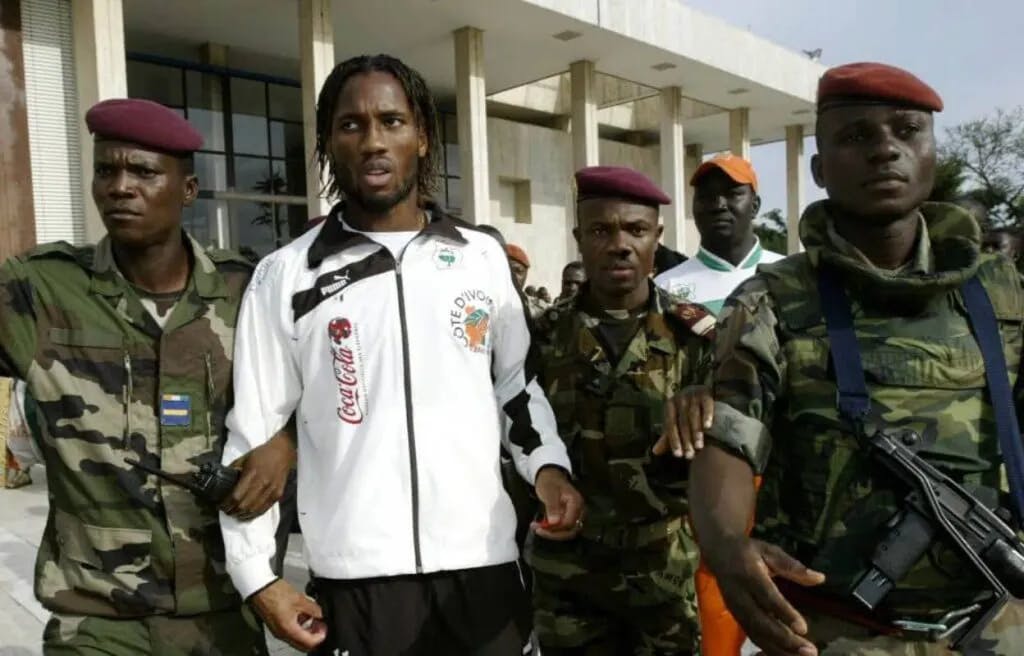
In October of 2005, the national team triumphed over Sudan with a score of 3-1, marking their maiden qualification for the World Cup. Rather than reveling in the victory, Chelsea forward Didier Drogba, who later played for Montreal Impact and Phoenix Rising, appeared before the camera holding a microphone in his right hand.
While standing alongside his teammates — current Manchester City assistant coach Kolo Toure wrapped his left arm around Drogba — he addressed the ongoing civil conflict in their homeland between the forces of President Laurent Gbagbo and rebel troops. The United Nations Refugee Agency (UNHCR) indicated in October 2021 that the upheaval resulted in the displacement of 750,000 individuals between 2002 and 2007. Precise death toll figures are elusive, but estimates suggest between 1,000 and 3,000 fatalities.
“Women and men of Ivory Coast. From the north, south, center, and west, we demonstrated today that all Ivorians can live together and compete with a united goal — to reach the World Cup,” Drogba affirmed. “We promised that the festivities would bring our people together — today we implore you from the depths of our hearts. Forgive. Forgive. Forgive.”
Drogba, who spoke in French, knelt down with his teammates and began to chant, “Stop firing your guns.” The short video, lasting just a minute, continues to resonate even now.
“Drogba is an outstanding forward who has had an amazing career, and he is a kind individual,” remarked Aruna Dindane, who scored two goals for the Ivory Coast against Sudan that day, to The Athletic. “It was something that emerged from the heart and contributed to unity for the benefit of great individuals.”
The roots of the initial Ivorian civil war can be traced back to the passing of Felix Houphouet-Boigny in 1993. Houphouet-Boigny served as the first president of the nation after it gained independence from France in 1960 and held his position until his death. He played a pivotal role in substantially enhancing the Ivory Coast's economy by boosting the production of cocoa, coffee, coconuts, and pineapples.